
Reimagining Work in the New Norm: Exploring the Exponential Workplace
Today's organisations face rapid skills disruption, talent shortages, and accelerating digital transformation. The Exponential Workplace moves beyond hybrid work to platform-based, agile, continuously reskilling organisations. Based on insights from the Asian Productivity Organization and Azim Pawanchik, it enables faster workforce transformation, capability building, and scalable value creation in the future of work.
The Unintended Consequences of the New Normal

Before the global pandemic, the transition to remote work was a slow-moving target, often suffocated by traditional office bureaucracy and a total lack of digital urgency. For years, the "before times" were defined by a glacial pace of change. Then came the "burning platform." The crisis forced a digital leap that was previously thought to be decades away.
The data is staggering: according to a Deloitte study, the adoption of remote work and collaboration tools – a shift estimated to require 454 days – was achieved in a mere 10.5 days. Similarly, the implementation of advanced technologies for business decision-making plummeted from an estimated 635 days to just 25.4. We did not just change; we underwent a forced evolution.
However, as a Workplace Futurist, we see a dangerous lethargy setting in. While organisations survived the initial shift, employees are now "tearing at the seams." The "new normal" has birthed a digital overload of endless back-to-back video calls and relentless chat notifications. Simply decreeing a "hybrid" schedule – three days in the office and two at home – is not a strategy; it is a superficial variation of an obsolete model. We are attempting to run 21st-century software on 19th-century organisational hardware, and the system is crashing.
Takeaway 1: Beyond the Hybrid Model —The Platform Approach
To survive the coming decade, we must recognise that "hybrid" is a transitional state, not a destination. We must adopt the architectural agility of "Aggregator" giants like Airbnb, Grab, and Gojek. This is the Platform Approach to Work. These companies do not just provide services; they provide a digitally enabled infrastructure that connects needs with solutions with zero friction.
This marks the mandatory shift from "place-based" work to "network-based" work, the hallmark of Organisation 3.0. These organisations are porous by design, embracing a "staff-on-demand" model that integrates external gig workers and experts seamlessly into project-based teams. In this environment, the organisation is no longer a building; it is a hyper-connected network.
Leadership in this decentralised architecture must also evolve. As Deborah Ancona, Professor at MIT, asserts, in a connected age, leaders must move toward "distributed leadership" and "instill passion and purpose around a shared mission." The futurist imperative for leadership is no longer to command and control, but to architect the partnerships and trust mechanisms that allow small, agile teams to self-organise and thrive.
Takeaway 2: The Four Villains Crushing Your Productivity
Traditional organisational structures impose "taxes on human achievement" that drain the lifeblood of innovation. To build an exponential workplace, we must identify and eradicate four primary villains: Bureaucracy. Walmart CEO Doug McMillon rightly identifies this as a "villain," while Charlie Munger of Berkshire Hathaway famously compares its growth to "cancers." It saps initiative and punishes the very risk-taking required for survival.

Bureaucracy: Walmart CEO Doug McMillon rightly identifies this as a "villain," while Charlie Munger of Berkshire Hathaway famously compares its growth to "cancers." It saps initiative and punishes the very risk-taking required for survival.
Hierarchy: Expert Kate Sweetman highlights the danger of "Power Distance", the degree to which employees accept unequal power distribution. Particularly in many Asian cultures, high power distance ensures that lower-level employees unfailingly defer to authority, causing the organisation to miss critical risks and innovative breakthroughs.
Silos: Whether functional or geographic, silos breed internal rivalry and lethargy. They act as barriers to the essential sharing of data and expertise, destroying workplace cohesion.
Cognitive Bias: These subconscious shortcuts lead to catastrophic decision-making. We must actively counter four specific biases: Myopia (overvaluing the near term), Risk/Loss Aversion (the paralysing fear of failure), Status Quo Bias (clinging to the familiar), and Authority Bias (deferring to titles over facts).
Takeaway 3: The 4Ds of the Exponential Workplace
To transform knowledge work into a competitive engine, we must apply the "4D Concept" of exponential organisations to the internal architecture of the office:
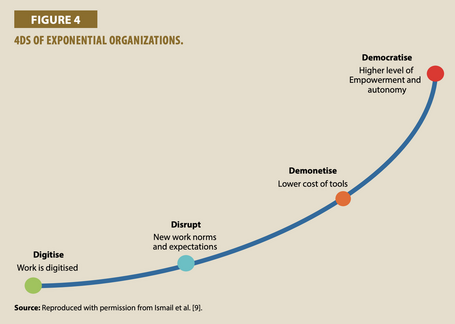
Digitise: Every interaction must be captured. When meetings are recorded and transcribed, and signatures are digital, information becomes a searchable, liquid asset.
Disrupt: Digitisation disrupts the "physical presence" mandate. Work is no longer a location; it is a flow of value that can happen anywhere.
Demonetise: Modern collaboration tools have effectively demonetised the cost of coordination. Furthermore, this shift drastically lowers operating expenses (OPEX) by eliminating the need for massive office footprints, parking, and excessive travel.
Democratise: This is the ultimate objective. By making tools and information accessible and affordable, we democratise the ability to contribute.
Takeaway 4: The Power of Asynchronous Collaboration
The primary antidote to digital fatigue is asynchronous collaboration. In a platform-based workplace, the requirement for everyone to be online simultaneously is an antiquated constraint that creates massive latency.
By virtualising decision-making through digital polls, chat functions, and voice-to-text transcripts, we can replace day-long status meetings with "asynchronous updating." This allows teams to:
Consume critical information and provide feedback at their peak productivity hours.
Utilise recorded video updates to communicate progress with rich context, undistorted by verbal interpretation.
Reduce the "latency" of decision-making, moving from a culture of "waiting for the meeting" to a culture of continuous momentum.
Takeaway 5: Mastering the "Hybrid Mindset"

The leaders of the exponential workplace must master a dual-mode of operation, toggling between these two distinct mentalities:
The Digital & Efficiency Mindset (Offload and Scale)
Offload predictable logic to algorithms: Use data and automated workflows for routine, consistent tasks.
Scale through virtual collaboration: Prioritize digital-first interactions to maximise time and reach.
Prioritise security architecture: Ensure data privacy is baked into the platform.
Architect exponential impact: Focus on massive cost savings and operational efficiency.
The Innovative & Experimentation Mindset (Human-Centric Value)
Harness collective intelligence: Use the platform to source ideas from every level of the organisation, not just the top.
Mandate experimental cycles: Dedicate specific time for teams to pilot new tools and "learn by doing."
Co-create via high-trust relationships: Use technology to facilitate deeper human connections and prototype new solutions.
Architect competitive edge: Focus exclusively on high-value, creative problem-solving that cannot be automated.
Conclusion: The Future is Experimental
The transition to an exponential workplace is not a one-time migration; it is a permanent state of evolution. There is no "proven model" to copy-paste into your organisation. Success belongs exclusively to those leaders brave enough to navigate unknown territories through constant trial and error.
This raises a critical question: Is your organisation currently in "hibernation mode," holding on to the hope that the old working ways will return? Or are you actively architecting a Platform Approach to work? The future of work will not be defined by where people sit, but by how effectively organisations connect, empower, and democratise talent at scale. Is your organisation built for the past, or is it ready to go exponential?
If you want to go deeper, explore the full report for actionable perspectives on building organisations fit for the future. And if you want to turn those ideas into capability, the Exponential Workplace e-course – brought to you by the Asian Productivity Organization (APO), designed and delivered by Azim Pawanchik from Alpha Catalyst – offers a pathway to learn and get certified by APO. The course equips participants with practical skills to leverage digital tools, strengthen collaboration, and make better data-driven decisions in today’s fast-evolving workplace.