
How Visionary Leaders Use Digital Platforms to Accelerate Innovation
By Dr Suraya Sulaiman & Azim Pawanchik

Digital platforms are quickly becoming an essential component of an organisation's innovation and transformation journey, providing structure, traceability, and inclusivity. More importantly, these digital innovation management platforms are able to furnish leaders with necessary data, supporting them through the many activities which are core to the transformation effort. This article strives to guide the visionary leader to leverage the power innovation management tools offer, to make exponential transformation a reality.
The Shift to Systematic Innovation
Innovation has now been recognised as an important component for economic growth and competitiveness in today's rapidly changing and increasingly globalised world. Many organisations are placing a greater emphasis on it as a way to stay ahead of the curve and meet the changing needs and expectations of customers, employees, and stakeholders.
The pandemic accentuated the need for organisations to be more agile and adaptable in order to survive and thrive, with many having to pivot their business models. Gone are the days when innovation can be a once-off gamble or an ad-hoc activity. Leaders need to steer innovation in a more predictable and systematic manner, crystalising the focus and defining the expertise needed to navigate this process.
Systematic Innovation Management and ISO 56000
The goal of innovation is to create value for the organisation and its stakeholders through the introduction of new products, services, processes, or business models. By following a structured and systematic process, organisations can proactively identify and address emerging challenges and opportunities.
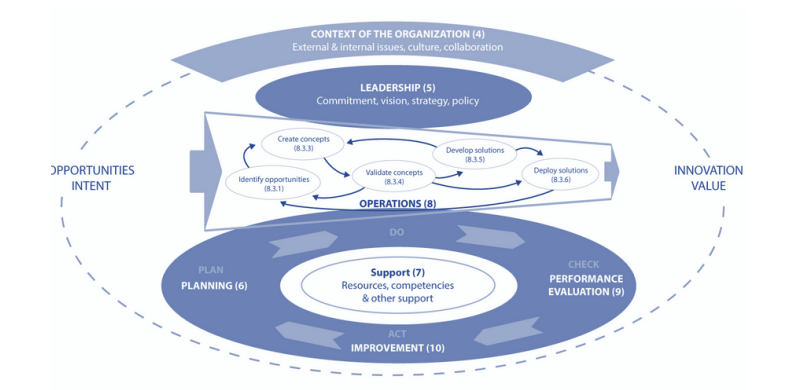
The ambiguous and diverse approaches in managing innovation spurred the creation of the ISO 56002 standard for innovation management in 2019. Embracing and aligning with globally recognised Innovation Management standards bolsters credibility and positions the organisation as a forward-thinking entity.
Due to the elaborate nature of the entire process, larger organisations are adopting innovation management software to manage the entire ecosystem. The adoption of software becomes crucial as teams get leaner, and as innovation becomes the responsibility of all.
6 Key Focus Areas for Future-Focused Leaders
Based on core innovation management principles, digital innovation management platforms provide approachable tools to assist future-focused leaders in six key areas to realize value seamlessly.
1. Exploiting Insights
Insights can come from anywhere within the organisation, from employees at the front-end, attending to customers, or from internally facing employees at the procurement or engineering division. It is important that everyone, no matter where they are within the organisation, has access to a system that will capture their insights or observations.
2. Setting a Strategic Direction
Leaders play a key role in setting the vision and direction for the organisation, including defining its objectives and strategies. Suggestions on focus areas may also arise from the insights or opportunities identified by employees. This offers a great opportunity to engage employees, whereby they are able to contribute feedback, ideas, or input. At a later stage, these platforms facilitate communication of progress, keeping employees further engaged through two-way communication.
3. Systems Approach & Knowledge Graphs
The systems approach in principle means looking at the organisation as a whole, and considering the interactions and dependencies between different parts of the organisation. This requires a leader who involves and seeks an assortment of viewpoints and insights. Where leaders can truly scale this is by leveraging the augmentation power of knowledge graphs. A knowledge graph is a way to formally illustrate a network or a collection of interconnected objects, visualising relationships between various data points. In such a graph, information is ordered with nodes depicting data points and edges depicting connections of interest, helping the leader assimilate research from seemingly unrelated data sources.
4. Managing Uncertainties
Innovating is almost always associated with experimentation and exploration. Here, the future-focused leader needs to be able to manage the risks associated with innovating by taking a portfolio approach to innovation projects. This enables the exploration of opportunities varying in both risk levels and potential impact, balancing core expertise with adjacent and completely new initiatives. In this context, the digital platform plays a moderating role, allowing leaders to visualize project portfolios and receive feedback from a broader circle of experts.
5. Adaptable Structures
Adaptable structures refer to the ability of the organisation to shift and adapt to new circumstances or quickly respond to new opportunities. For leaders, handling shifting teams and emerging projects while maintaining clear communication can be challenging. Here is where digital platforms offer respite. Offering transparency, empowerment, and end-to-end oversight of projects, leaders are able to access real-time updates and monitor projects effortlessly. Flexible job roles can also empower employees to take ownership of their work while digital platforms empower employees to make decisions that align with organizational goals.
6. Promoting an Innovation Culture
To get innovation to flourish, leaders can create a sense of ownership and accountability within the organisation. Online activities can be complemented by in-person activities, such as holding purpose-driven campaigns, competitions, or solution hackathons. Another aspect of digital platforms which can be leveraged is the use of incentives or gamification elements to encourage active involvement. Points, badges, and leaderboards can be awarded to users who contribute to the organisation's innovation journey, making participation approachable and engaging.
Realising Value: The Ultimate Objective
The ultimate objective of innovation is to create value for the organisation. Therefore, leaders will always be pressed to ensure performance of their employees and organisation. When implementing initiatives, it is essential to effectively measure impact and outcomes. Digital platforms are valuable tools in this regard, offering real-time data analytics and oversight, as well as consolidating both financial and non-financial measures for comprehensive reporting. Going forward, leaders can make more informed decisions and prioritize higher-value activities, while maintaining seamless oversight of innovation efforts.
Read more in the article.
About the Authors
Dr Suraya Sulaiman is an Innovation Provocateur at Alpha Catalyst, a boutique innovation consultancy specializing in culture and capability development.
Azim Pawanchik is an Innovation Strategist at Alpha Catalyst and a leading expert on innovation strategy, analytics, and open innovation frameworks in Asia.